Be a speaker at this December’s Spark@AGU! Learn more and submit a talk idea by October 19.

ESIP: The Mesh Network of People
This is ESIP’s 28th year. That gives us just two years until our fourth decade begins! Now is the time to start planning where ESIP wants to be for the next 30 years of its history. At the Austin July 26 meeting, the ESIP community began putting details on what that vision looks like.
ESIP has always built on a strong foundation in Earth science innovation. We formed in response to a National Academies recommendation to involve the Earth science community in developing methods to make data easy to preserve, find, and use. ESIP was founded by some of the same passionate community members who still serve as volunteer leaders today! ESIP’s original split structure, as a Federation and Foundation, brought together research and applications development communities as well as NASA data archive centers to work on shared priorities. ESIP’s first decade integrated a collection of projects focused on making Earth science data easy to preserve, locate, access, and use. In the second decade, ESIP’s Foundation and Federation merged, ESIP’s partner list expanded, and Collaboration Areas and Clusters took off. In more recent years, as a single united nonprofit organization, ESIP has cemented its true identity, mission, and values. It’s a rare, welcoming space where so many of us can genuinely say, “ESIP is where I found my people.”
Now we need the community’s input and energy to help us clock another 30 incredible years. Changes in federal agency staff and processes have stretched our community thinner than ever and shaved down the federal support ESIP receives. We’re trying to lighten the load on community members by working smarter. We’re auditing every dollar. Core programmatic offerings have been trimmed, and we are seeking more sponsorship support than ever.
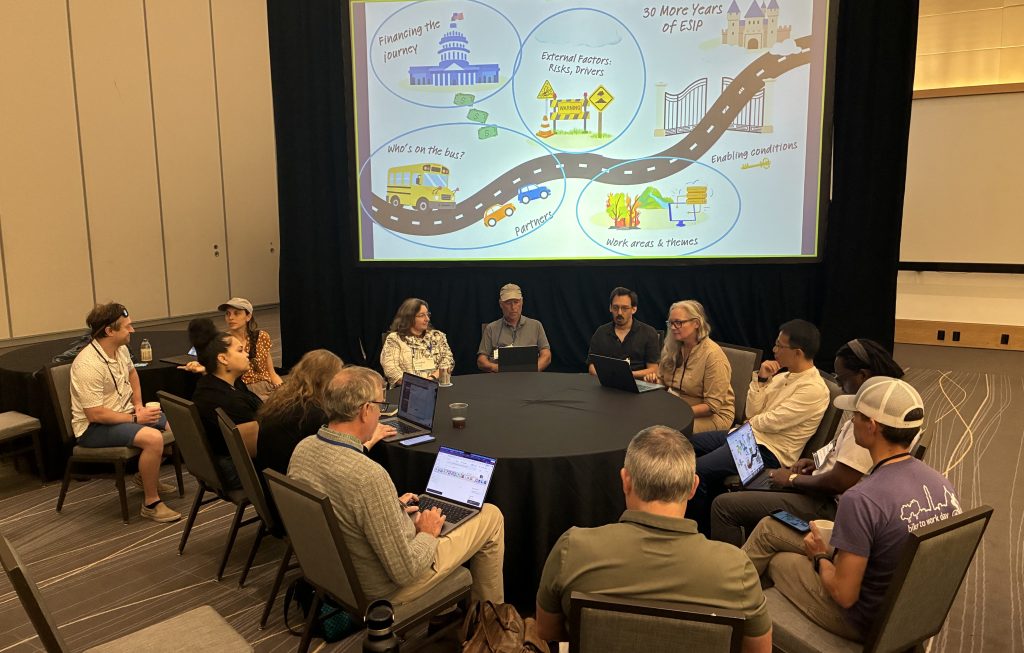
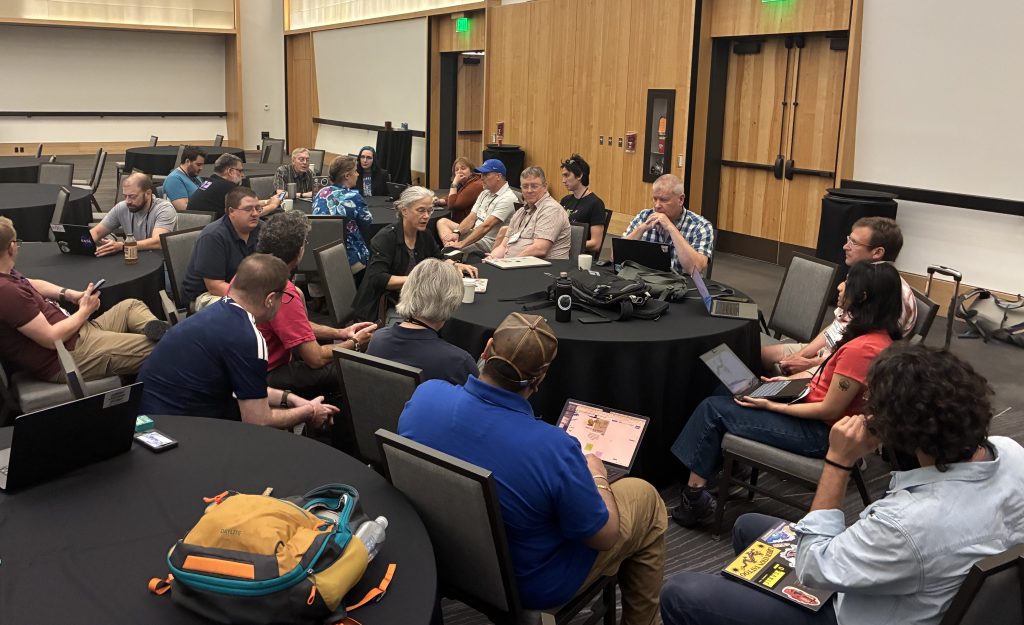
Yet, the demand for what we do has never been higher. ESIP’s ability to bring people together to make Earth science data actionable is completely unmatched. To plan for the next 30 years, we recently put our community to work to focus on four vital brainstorming themes. The closing plenary and Annual Business Meeting at the 2026 July ESIP Meeting featured breakout discussions of what this “Road to 30” needs to involve. Here is what the community told us.
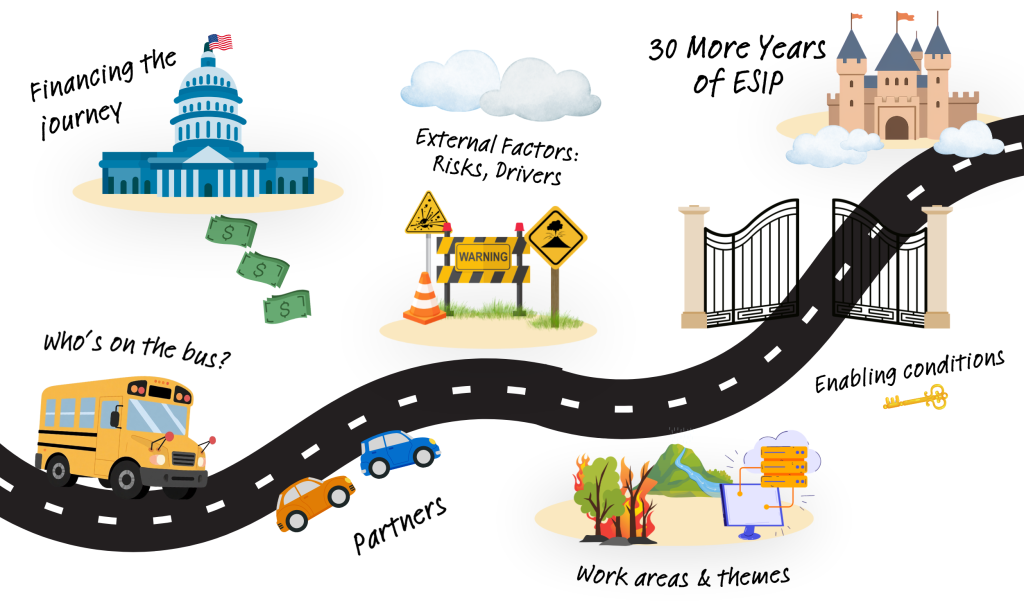
Financing the Journey: Diversifying Our Revenue
To build long-term financial stability beyond federal grants, ESIP must proactively engage the private sector, philanthropy, and non-granting agencies. High-priority actions include clearly communicating ESIP’s value to current and potential supporters, securing corporate in-kind support (such as computational resources or tutorials by tech leaders), and raising awareness among lawmakers and partner agencies about what ESIP uniquely provides. Additional creative strategies could involve establishing an endowment, activating local chapters, and directing corporate sponsorships towards ESIP Labs. Other ideas focused on research-to-operations activities targeting federal science initiatives (e.g., NSF TIP) and spin-offs. Underpinning these ideas is a mandate to clarify ESIP’s impact and examine broader revenue generating options like donations from foundations, individuals, or donor-advised funds, and evaluate fee-for-service models.
Who’s on the Bus? Growing Our Community & Partnerships
Expanding our influence and solidifying ESIP’s niche requires two areas of work: intentionally elevating our “unicorns,” or the experts who seamlessly bridge data science and domain science, who can explain to many audiences what ESIP and its successes are all about; and improving our involvement of undergraduates, graduate students, and postdocs in ways that will increase the professional pipeline of new Earth system data science experts. One option to engage and reinvigorate partners is to collaborate with fellow nonprofits to host co-branded, skill-building events. We can showcase our capabilities through domain-specific webinars and directly involve practitioners from science agencies, local bodies, and contracting firms. Looking further out, ESIP can connect with regional and international groups, commercial space data providers, and LLM developers who rely on open Earth science data. Community feedback emphasized simplifying onboarding for newcomers and providing recaps of long-running discussions to assist with attracting and retaining new experts. Innovation in this space could look like developing ways ESIP can provide services to support other groups in open governance and inclusive meeting design.
Work Areas & Themes: Staying at the Cutting Edge
To stay true to its roots, ESIP must maintain its technical edge by advancing metadata, standards, and semantic tools that now serve both human researchers and automated systems like AI agents. Unique offerings that ESIP could provide in this space could include creating a crowd-sourced “Awesome-ESIP” skills repository, a dedicated agentic coding cluster, and resource cards for informatics services; as well as facilitating agent-driven workflows for Earth data access. Better inter-Cluster coordination and structured partnerships with major integrative institutions like AAAS, NIST, and National Academies will enable cross-disciplinary adoption of ESIP-rooted innovations. ESIP can also cement its status as a leader by educating broader public audiences on why informatics matters, collaborating with adjacent domains like heliophysics, and supporting federal infrastructure updates. As ESIP’s focus shifts from raw data management toward holistic knowledge systems, it’s important for us to carefully balance volunteer bandwidth against high-impact deliverables.
External Factors: Risk Management & Adaptive Strategy
No matter how strong ESIP is as an organization, external factors will always pose challenges. One strategy to mitigate risk from shifting political mandates and long-term federal funding declines is to invest in active, clear communication about ESIP’s value, victories, and potential. Rising travel costs and shrinking university pipelines threaten meeting attendance and incoming talent, while rapid technological shifts like the widespread embrace of AI tools instead of human experts obscure the importance of human connections and experts behind the data. To navigate these headwinds, ESIP can expand its international footprint, build relevance beyond our core “choir,” and pivot messaging toward economic impacts for key audiences. Structuring Cluster activities around short-term, project-focused milestones can allow ESIP to capture flexible funding while remaining anchored in our foundational mission and open-science values.
Synthesis: The Connected Path Forward
All of these four areas are interconnected. Diversifying ESIP’s revenue relies directly on showcasing the community’s cutting-edge outputs. Delivering more technical breakthroughs requires cultivating a steady pipeline of “data science unicorns” and early-career talent. Buffering against external risks forces us to expand commercial partnerships, international ties, and corporate sponsorships.
The key balancing act will be to scale ESIP’s private-sector relationships without compromising our open-science integrity or exhausting our volunteer community. As we translate technical achievements into clear success stories and expand beyond traditional channels, we can also protect the core of what makes ESIP unique: its dedicated people, ideas, and values.
What Lies Ahead
As ESIP looks toward our fourth decade, our community energy and expertise will power our success. We will continue to be the premier professional Earth system data science pipeline builder that nurtures undergraduates, postdocs, and cross-domain experts into the field’s most recognized leaders. ESIP meetings will continue to be the indispensable networking events where agencies, academics, and industry partners gather to get the hardest, most complex work done with all the right people around the table. By staying at the forefront of AI workflows, standards, and data stewardship, ESIP leaders will ensure that we stay in step with the needs and grand challenges of our federal partners, and push the entire field towards greater success.
Together, we are setting the stage for 30 more years of a thriving, groundbreaking ESIP. Let's get to work!
ESIP (Earth Science Information Partners) is a community of partner organizations and volunteers. We work together to meet environmental data challenges and find opportunities to expand, improve, and innovate across Earth science disciplines. Learn more and sign up for the weekly ESIP Update for #EarthScienceData events, funding, webinars and ESIP announcements.