Submit your session proposal for the ESIP January 2027 Meeting. Submissions are open through November 19.

New Findings on Building Resilience During Crisis

Authored by Alycia Crall (ESIP) and Talisha Sutton-Kennedy (Tessera Strategies)
What would happen if the data you rely on tomorrow simply disappeared today? Data repositories are more fragile than we think
For many researchers, emergency managers, policymakers, and community organizations, that question is no longer hypothetical. Over the past year, growing concerns about funding cuts, workforce reductions, cyber threats, and the removal of public datasets have highlighted a troubling reality: the repositories that preserve and provide access to critical data are increasingly vulnerable.
To better understand these risks, the project, Building Resilience of Data Repositories During Periods of Crisis, brought together repository administrators, technical staff, data users, and citizen archivists from around the world. Through focus groups, surveys, and use of the Repository Crisis Scorecards (RCS), the project examined how repositories experience disruption, what happens when systems fail, and what can be done to strengthen resilience.
Today, we are excited to share two new resources from this work: a white paper, Repository Resilience in Practice: Findings and Strategies from a Community in Crisis, and the updated Repository Crisis Scorecards (RCS) Version 2.0. Together, these resources offer both a deeper look at what we learned and a practical tool for assessing and strengthening repository resilience.
What You'll Find in the White Paper
The white paper combines repository self-assessments, surveys, and focus group discussions from repository administrators, technical staff, data users, and citizen archivists across more than 14 countries. Together, they paint a picture of a community working hard to protect critical data while facing growing uncertainty.
Among the findings, one pattern stood out: repositories are generally well-prepared for routine operations, but far less prepared for major disruptions. From the paper: “Some systems are running with people on renewable three-month contracts. So it's inherent that the system’s going to fail if the critical staff are all on short-term contracts.”
The report explores three interconnected challenges affecting repository resilience today:
- How funding instability and policy changes can disrupt access to critical data
- Why the loss of specialized staff and institutional knowledge creates hidden vulnerabilities
- How infrastructure failures, cyber threats, and other technical disruptions can impact data access when it is needed most
Alongside these challenges, the white paper highlights practical strategies already being used by repositories to strengthen resilience, as well as recommendations tailored for repository administrators, researchers, citizen archivists, funders, and policymakers.
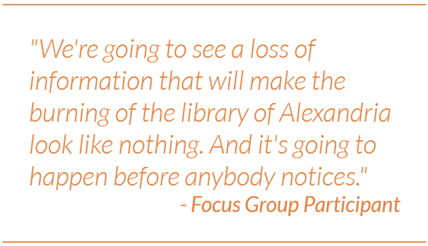
As one project participant cautioned, “We're going to see a loss of information that will make the burning of the Library of Alexandria look like nothing. And it's going to happen before anybody notices.” The good news is that resilience is achievable, and the report highlights concrete actions that can be taken now to reduce risk before the next disruption occurs.
Explore the new resources
Repository Resilience in Practice: Findings and Strategies from a Community in Crisis
Read the white paper to explore the full findings, community insights, and practical recommendations.
Repository Crisis Scorecards (Version 2.0)
The updated Repository Crisis Scorecards provide a practical self-assessment tool for evaluating repository resilience under both routine operations and crisis conditions. Version 2.0 incorporates extensive community feedback to improve clarity, usability, and applicability across a wide range of repository contexts.
Join Us for a Webinar
To introduce these resources, we will host a webinar on July 16 from 4:00–5:00 PM Eastern Time (find your time). During the webinar, we will share highlights from the white paper, demonstrate the Repository Crisis Scorecards Version 2.0, and answer questions from the community.
Register: esipfed.org/rcs-webinar
This project was funded by the Alfred P. Sloan Foundation, grant number G-2025-79191.