Be a speaker at this December’s Spark@AGU! Learn more and submit a talk idea by October 19.
Evolution of the Community Fellows Program: Piloting a New Vision for the Future

Since 2011, the ESIP Community Fellows Program has served as a gateway for early career researchers to connect with the Earth data science community. Through collaboration with ESIP’s Clusters and participation in ESIP Meetings, Fellows have built professional networks, gained valuable experience, and contributed to community-driven projects.
When I joined ESIP in 2025, one of my responsibilities was supporting the Community Fellows Program. As I became familiar with the program and spoke with current and former Fellows, I saw an opportunity to better understand the program's impacts and explore ways it could evolve to meet the changing needs of early career professionals. While the Fellowship has long provided meaningful experiences, I began to wonder whether a Fellow's first and second years could offer distinct opportunities for growth rather than largely repeating the same experience.
This question sparked a broader effort to assess the current program and explore possibilities for its future.
Listening First: Evaluating the Program
Before considering any changes, I wanted to better understand the experiences of those who had participated in the Fellowship and the impacts the program had on their careers.
To do this, I designed and conducted two evaluation efforts. The first focused on the 2025 cohort of Community Fellows and explored their experiences, including networking and collaboration opportunities, skills gained, satisfaction with the program, and recommendations for improvement. The findings from this work were recently published in an ESIP Community Report.
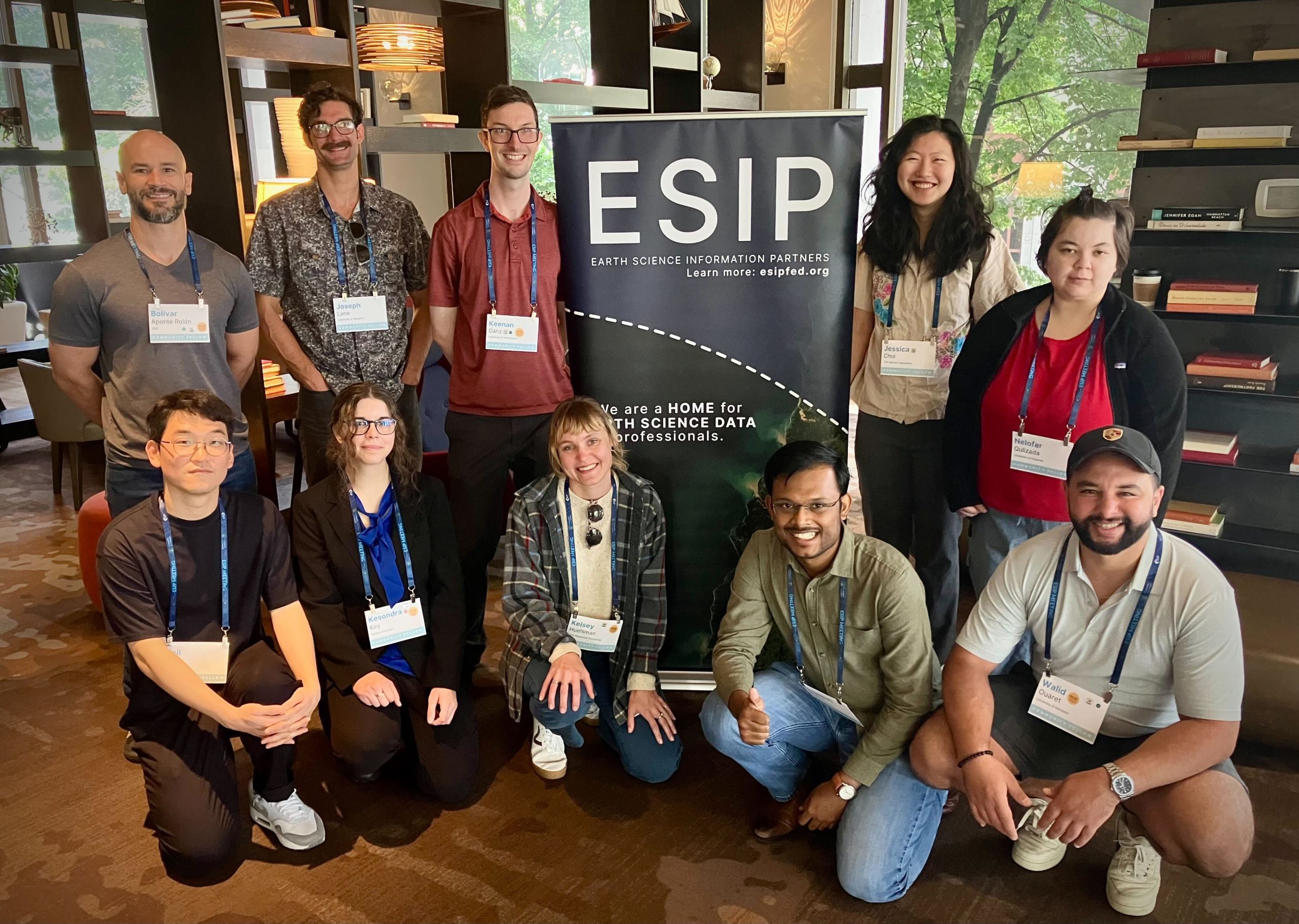
The second effort focused on Community Fellows alumni. Through a survey of past participants, I sought to better understand the longer-term impacts of the program on career development and professional growth. The results were encouraging: alumni consistently reported that the Fellowship had a lasting influence on their careers, helping shape professional pathways, expand networks, and strengthen both confidence and a sense of belonging within the Earth data science community.
Together, these evaluation efforts provided a strong foundation for considering how the Fellowship might evolve while preserving the aspects participants value most.
Exploring a New Two-Year Model
One theme that emerged from both current Fellows and alumni was the value of creating a more intentional developmental pathway through the program.
“The goal in developing the new fellowship model is to give students more support to be intentional, with greater opportunities for professional development.”
Joseph Lane
Rather than offering two largely similar years, a future Fellowship model could provide distinct experiences at each stage. The first year might focus on helping Fellows become integrated into the ESIP community, building connections, exploring collaboration opportunities, and developing professional skills. The second year could focus on leadership, providing opportunities to mentor newer Fellows, lead projects, and contribute more directly to the community's growth and direction.
This progression would create a pathway from community member to community leader while aligning training and professional development opportunities with a Fellow's evolving needs and interests.
Fellows’ Input, and Launching a Pilot Effort
As I began exploring what this future model might look like, I realized it would be valuable to involve Fellows who had recently completed the program and could provide firsthand perspectives on what worked well and what could be improved.
Two members of the 2025 cohort, Kelsey Huelsman and Joseph Lane, had expressed interest in returning for a second year. Given their experiences and enthusiasm for the Fellowship, I invited them to partner with me in developing and testing ideas for a new program model.
Kelsey served as a Fellow for the Biological Data Standards Cluster, while Joseph supported the Physical Sample Curation Cluster. Together, we are working to review evaluation findings, identify opportunities for improvement, and pilot approaches that may help shape the future of the Community Fellows Program.
Their experiences as recent Fellows bring an important perspective to this effort, while also providing them with opportunities to further develop skills in program development, community leadership, and mentorship.
Kelsey, who was engaged with ESIP a year before becoming a Fellow, shares how a new two-year model might be more impactful. “The feedback from my cohort of Fellows demonstrates how useful the Fellowship is, in terms of networking, career planning, horizon broadening, and skill strengthening. While I found the Fellowship useful in the same career-boosting ways my peers did, my previous ESIP engagement meant I gained more than those baseline benefits. I’d argue that ESIP also gained more organizationally.”
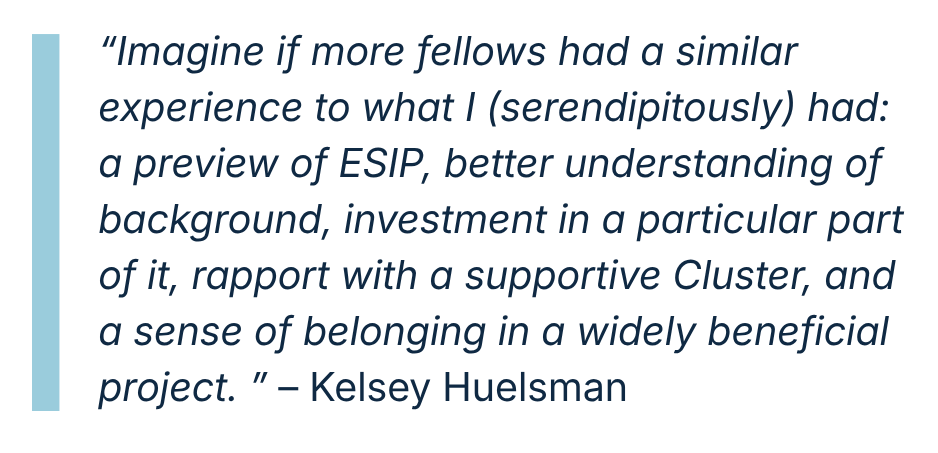
She further speculates, “Imagine if more fellows had a similar experience to what I (serendipitously) had: a preview of ESIP, better understanding of background, investment in a particular part of it, rapport with a supportive Cluster, and a sense of belonging in a widely beneficial project. What if the larger “beneficial project” was connected to a chapter of that graduate student’s dissertation? What if that graduate student received invaluable feedback through the Cluster to develop that chapter? Finding these points of synergy could mean success on all fronts, both within ESIP, for that Ph.D. student’s successful graduation, and for the broader community of Earth Scientists.”
Joseph shares similar thoughts. “Coming to the Program with fresh eyes allowed me to see the incredible efforts that so many people are putting in to create these systems and appreciate the often thankless work that is being done,” he says. “It also gave me many ideas for how different systems could be connected… I believe this Fellowship has the opportunity to work with the various groups within ESIP to create a path for Fellows to engage not just with a single group, but to facilitate cross-collaboration and encourage greater community integration, allowing Fellows to move between groups, develop projects with other Fellows, and leverage working group mentors to guide them along their fellowship.
“The goal in developing the new fellowship model is to give students more support to be intentional, with greater opportunities for professional development such as grant writing,” Joseph continues. “We aim to create a scaffolded program that builds progressively on Fellows' interests and skills, facilitating focused, project-based Fellowships and collaboration within working groups and across the community as a whole, whether that means co-authoring a paper or assisting in the creation of a tool or resource that complements their research, then sharing it with the community.”
Opportunities to Engage
The future of the Community Fellows Program will be strongest if it is shaped by the broader ESIP community.
With more than 190 partner organizations and a diverse network of Earth data science professionals, there are countless opportunities to support Fellows through mentorship, professional development, collaborative projects, and community leadership.
If you are interested in serving as a mentor, connecting Fellows with opportunities, or contributing ideas as we explore the future of the program, please email me at [email protected].
Joseph, Kelsey, and myself will also be leading a session at the ESIP July meeting (Session Title: Evolution of the Community Fellows Program) on Wednesday, July 29 at 4pm central time where you can join the discussion and share your feedback (register). We would love to have you join us!
ESIP (Earth Science Information Partners) is a community of partner organizations and volunteers. We work together to meet environmental data challenges and find opportunities to expand, improve, and innovate across Earth science disciplines. Learn more and sign up for the weekly ESIP Update for #EarthScienceData events, funding, webinars, and ESIP announcements.