Deadline Friday! Apply for the ESIP Raskin Scholarship by March 13. Learn more and apply.
Celebrating our 2026 ESIP Award Winners
Earth Science Information Partners (ESIP) celebrates the 2026 award winners who step up as excellent data stewards, community organizers, and enthusiastic volunteers. This year, ESIP recognizes a handful of people who do the work, build community, and go above and beyond, while also recognizing that ESIP thrives because of the work of so many dedicated professionals.
2026 ESIP Award Winners
Each year, the ESIP community recognizes the outstanding accomplishments, achievements, and service of individuals spanning Earth sciences, geoinformatics, data, and computing. The awards are presented during the closing plenary at the January ESIP Meeting.
“Our awards celebrate those who champion collaboration and open science in our community,” says Mark Parsons, Interim Executive Director for ESIP. “This year's winners really exemplify that collaboration, as well as resilience, interoperability, and true community spirit.”
“We remain a volunteer-powered engine, and it is the commitment of each individual that fuels our shared success,” states ESIP Executive Director Sarah Cooley. “We are so grateful to these exceptional members of our community for their creativity, time, and leadership.”

Upcoming ESIP Awards
We celebrate our amazing community all year long. From FUNding Friday to our Community Fellows, we make sure to offer opportunities for growth, recognition and novel ideas.
Our next award will be for graduate students seeking to build bridges between the Earth sciences and data science. Learn more about the Raskin Scholarship: esipfed.org/raskin
And stay up to date on all awards, funding opportunities, events and celebrations through the weekly ESIP Update: esipfed.org/subscribe
Martha E. Maiden Award Honors Lifetime Achievement
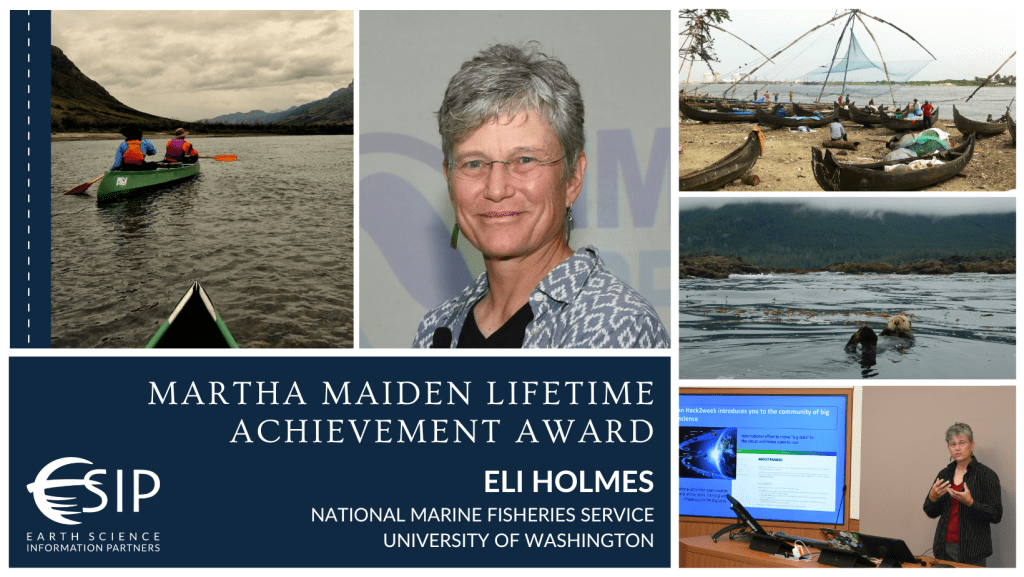
Named for Martha E. Maiden, former program executive for Earth Science Data Systems at NASA, this award honors individuals who have demonstrated leadership, dedication, and a collaborative spirit in advancing the field of Earth science information.
This year, the award goes to Eli Holmes. Since joining NOAA Fisheries in 2000, Holmes has specialized in population modeling to support collaborative conservation efforts for Pacific Northwest aquatic species. Her multidisciplinary background includes extensive post-doctoral research on spatial population dynamics and statistical analysis of noisy environmental data, and long-standing service as Affiliate Faculty in the University of Washington School of Aquatic and Fishery Sciences (where she teaches environmental time series analysis).
Holmes has many different leadership roles within the Earth Science information community, as a researcher, teacher, software developer, policy advisor, community builder, storyteller, and more. “Eli embodies the collaborative spirit that is central to both Martha Maiden's legacy and ESIP's mission,” wrote nominator Chelle Gentemann, Program Scientist at NASA. “What sets Eli apart is her ability to bridge organizational and cultural differences across agencies while maintaining focus on the broader Earth science information community's needs.”
Another nominator – Corinne Bassin, Schmidt Ocean Institute Head of Data Solutions – says Holmes’s work “strengthens scientists’ ability to produce transparent, reproducible, and accessible science, hallmarks of scientific integrity and public trust.”
Since October 2023, Holmes has served as the National Marine Fisheries Service (NMFS) Open Science Lead, driving the adoption of open practices and data modernization across NOAA Fisheries, helping scientists integrate transparent, reproducible workflows into their climate and ocean modeling. Beyond policy, she is committed to hands-on education through leading and mentoring roles with NMFS Openscapes and various international Earth Science HackWeeks, and is dedicated to the principles of Open Science.
What I do: Enable scientific communities by unblocking skills, confidence, and perceived institutional limits, helping groups see new possibilities and paths forward, with a focus on teams working with messy and large data problems.
Why I do it: I’m fascinated by how ideas, skills, and radical openness can catalyze organic change in scientific communities and expand what becomes possible.
Eli Holmes
President’s Award Honors Service
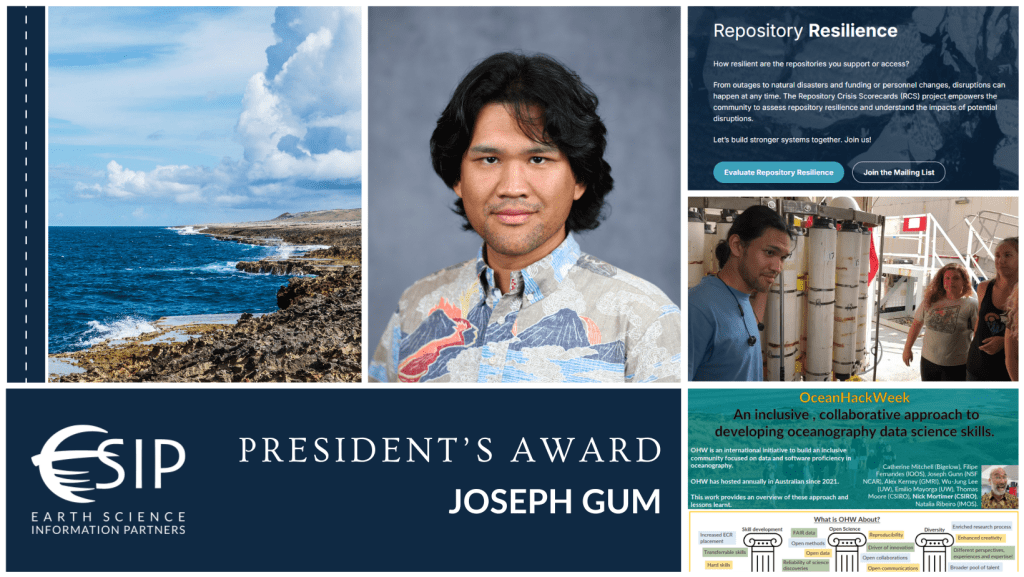
Selected by the ESIP President, this award recognizes a participant who has made significant, tangible contributions to ESIP.
ESIP President Yuhan (Douglas) Rao announced the award winner: Joseph Gum. Gum has recently been working with ESIP and the Sustainable Data Management Cluster to design and develop the Repository Crisis Scorecards, helping support research data management resiliency.
“In a year filled with tremendous uncertainty and disruption, Joseph's dedication and leadership to strengthen the resilience of the Earth science data ecosystem is an exemplar for what the ESIP community stands for,” writes Douglas Rao, ESIP President. “It brings me hope and joy to see community leaders like Joseph and the impact of the repository crisis scorecard that goes beyond the geoscience community.”
Gum describes himself as a research data management resiliency investigator, a data steward, and open science enthusiast. Previously, he has held roles at Scripps Institution of Oceanography, at NCAR, at the University of Hawaii at Manoa, and more.
What I do: Work that should be done, regardless of the circumstances; imagine a more resilient future for science, starting with the people and infrastructure that underpin everything else.
Why I do it: Because it should be done, and we should all help as much as we can.
Joseph Gum
Action is Inspired by Catalyst Awardees
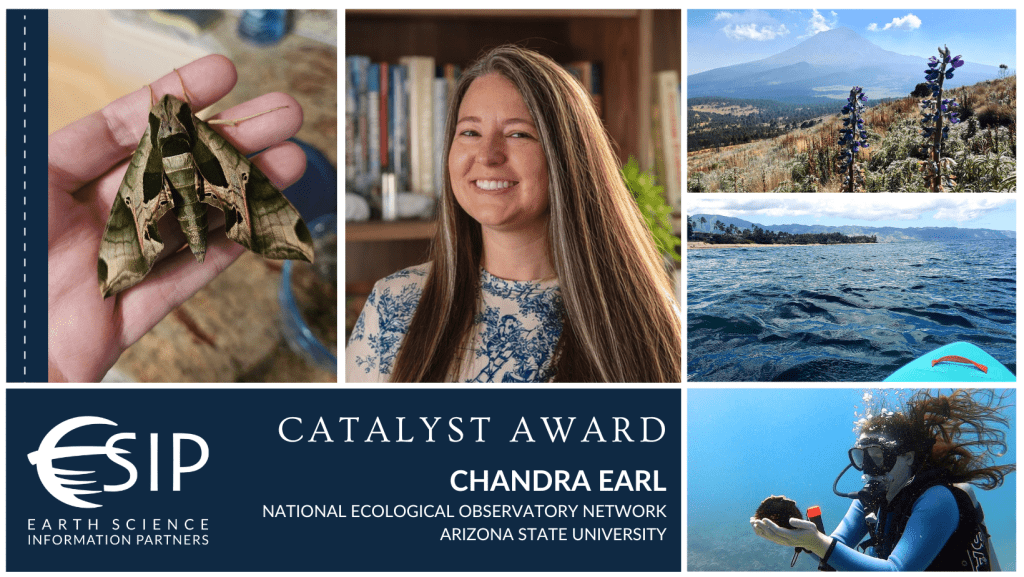
Given to participants who have brought about positive change in ESIP by inspiring other members to take action, this award recognizes exceptional volunteer efforts.
The Catalyst Award winner, Chandra Earl with the National Ecological Observatory Network (NEON), has chaired the Data Help Desk Cluster at ESIP, and with a 2024 FUNding Friday microgrant, led the creation of resources for anyone to easily host and facilitate a Help Desk at a science conference. The help desk is now available at conferences around the world.
Rao states, “ESIP strives to empower everyone to leverage Earth science information to address pressing societal needs. The Data Help Desk has always been an effective resource for the community. Chandra's leadership to envision a sustainable future of DHD embodies the core ESIP value of collaboration. The Data Help Desk Cluster will be a tremendous asset to amplify the value of Earth science data.”
Earl is currently a data scientist at the NEON Biorepository, hosted by Arizona State University. She has previously worked in various positions in biodiversity informatics at several institutions, specializing in sustainable data infrastructure for natural history and ecological research.
What I do: Build FAIR, integrated data infrastructure and conduct biodiversity research that connects natural history collections, DNA, and large-scale analyses.
Why I do it: Because most life on Earth doesn’t have a lobbyist.
Chandra Earl
Falkenberg Award Honors Contribution and Public Awareness
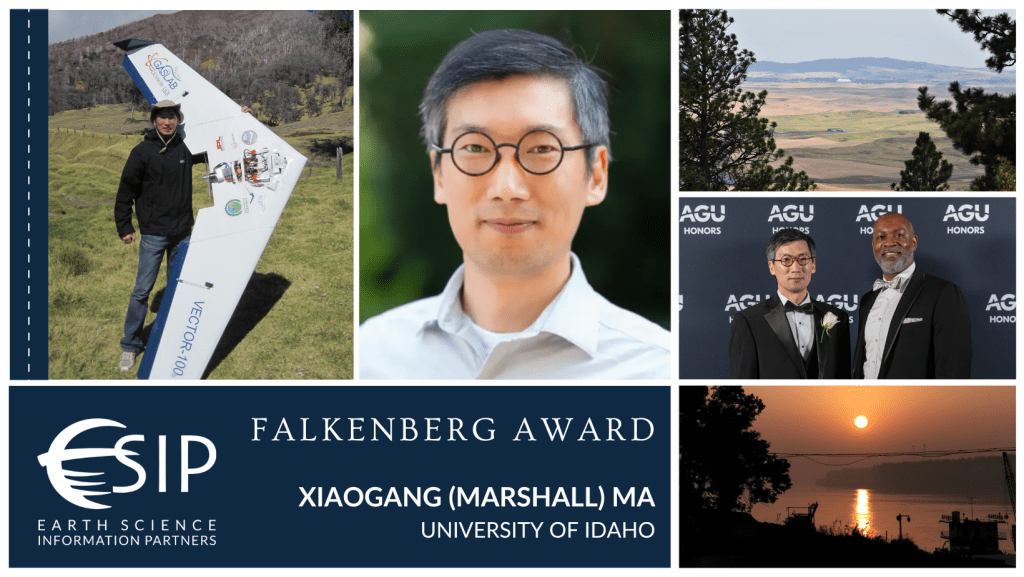
The Charles S. Falkenberg Award is a joint award through the American Geophysical Union (AGU) and ESIP. Part of the AGU Annual Meeting Awards Ceremony, the award recognizes an early to mid-career scientist who has contributed to the quality of life, economic opportunities and stewardship of the planet through the use of Earth science information and to the public awareness of the importance of understanding our planet.
Xiaogang (Marshall) Ma, Associate Professor of Computer Science at the University of Idaho, was chosen for enhancing public awareness and understanding of our planet through open data and scientific cyberinfrastructure in geo- and bioinformatics. He has emerged over the recent decade as a global leader in cyberinfrastructure and data science for Earth system applications, including as PI of TickBase, a $6.4M National Science Foundation project on tick-borne disease modeling.
Ma's academic background is in Earth Systems Science and Geo-information Science, with postdoctoral training in Data Science. His research focuses on deploying data science in the Semantic Web to support cross-disciplinary collaboration and scientific discovery.
What I do: Develop building blocks and frameworks in data science and AI for geosciences, such as vocabularies, knowledge graphs, databases, algorithms, and workflows.
Why I do it: To improve the utility of data and tools, facilitate interdisciplinary collaboration in research, and promote public awareness of the Earth.
Xiaogang (Marshall) Ma
Collaboration of the Year Awardees Build Bridges
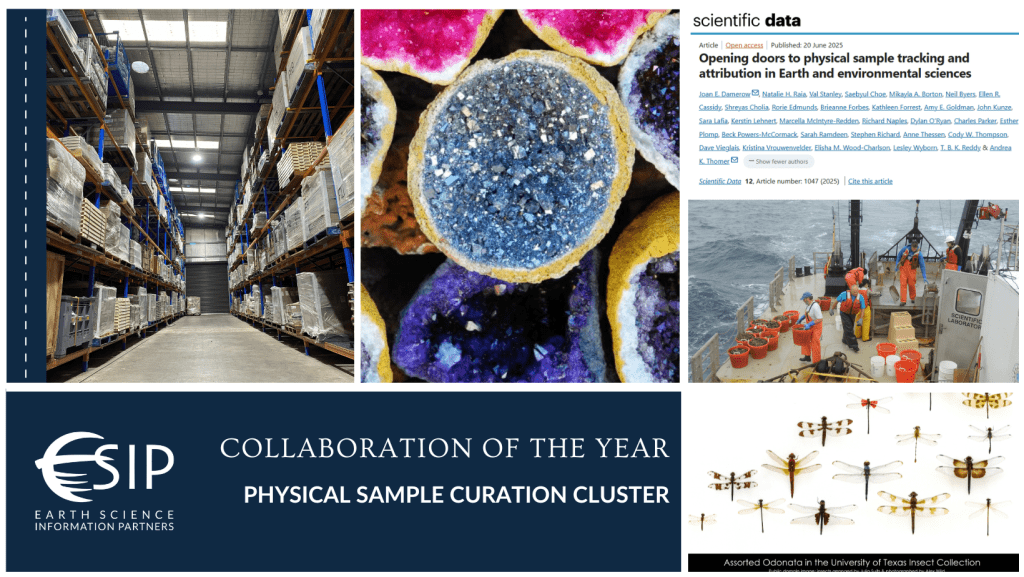
This award, selected by the Partnership Committee, honors an ESIP collaboration that exemplifies the spirit of ESIP in one or more areas, through the sharing of a success story. The committee defines a collaboration as two or more individuals or groups working together, and the joint effort does not need to be a formal collaboration.
The Physical Sample Curation Cluster is this year’s winner for Collaboration of the Year. This Cluster, currently led by Natalie Raia and Andrea Thomer, has been working for 4 years on the development of physical sample citation guidelines. In 2025, a refined version guidelines was published (currently under review for ESIP endorsement), plus a paper in Scientific Data (with over 30 authors, most from ESIP!) describing their work. They believe the guidelines will make it possible for collection managers, funders, and sample collectors to get more credit for their contributions to sample curation, and will enable further sample reuse.
The Cluster has worked for a long time to accomplish their current goals, with former leadership also including Joan Damerow, Sarah Ramdeen, and Val Stanley. They credit their ability to leverage ESIP's meeting structure and focus on data problems to create actionable guidelines for data citation and outlining future steps for work.
What we do: Enhance discoverability, access, and use of sample collections by providing a forum for information & curation professionals, cyberinfrastructure providers, and researchers to share practices and challenges.
Why we do it: Physical samples are vital elements of study in many disciplines, including earth and environmental sciences, biological sciences, archaeology, and beyond.
Physical Sample Curation Cluster